Your core is not just about flat abs or a strong stomach. For older adults, core strength is the foundation of everything – balance, upright posture, the ability to rise from a chair, and the confidence to move through daily life without fear of falling.
The good news? You do not need to get down on the floor, lift weights, or push through discomfort to build that strength.
The sitting core exercises in this guide are gentle, safe, and designed specifically for older adults. Every movement in this list can be done right from a sturdy chair – at home, at a senior center, or in a supervised daytime wellness program. No special equipment needed.
Benefits of sitting core exercises for seniors
Many people assume core exercises require getting on the floor or working at high intensity. In reality, chair abdominal exercises can deliver meaningful, lasting benefits for older adults – often without any of the strain associated with traditional workouts.
Here is what regular seated core training can do for you.
Improve balance and reduce fall risk
The muscles of your core, including the deep abdominals, lower back, and pelvis, are responsible for keeping your body upright and stable. When these muscles are weak, the body compensates with less efficient movement patterns, increasing the risk of stumbling or losing your footing.
Research shows that core strengthening is one of the most effective strategies for fall prevention in older adults.
Even gentle sitting exercises for the abdomen activate deep stabilizer muscles that support balance during walking, reaching, standing, and transitioning from sitting to standing.
Support better posture and back health
Years of sitting, reduced activity, and natural changes in muscle tone can contribute to a forward-slumped posture that places stress on the spine.
Seated core exercises – especially those that gently activate the lower back and abdominals together – help counteract this pattern.
Stronger core muscles take pressure off the lumbar spine, reduce muscle fatigue in the upper back, and encourage a more upright, comfortable seated and standing posture. Many seniors report less back discomfort after just a few weeks of consistent chair-based core work.
Strengthen abdominal muscles safely
Traditional abdominal exercises like crunches and sit-ups can be uncomfortable or risky for older adults, particularly those with osteoporosis, spinal stenosis, or recent abdominal surgery. Chair abdominal exercises offer a safer alternative.
Seated movements engage the rectus abdominis, obliques, and deeper transverse abdominis without placing the neck, hips, or spine in compromising positions. The result is meaningful core strengthening with significantly reduced injury risk.
Boost daily mobility and independence
Core strength underpins nearly every functional movement of daily life: getting in and out of a car, reaching into a cabinet, carrying groceries, bending to put on shoes, and walking confidently. When your core is strong, these tasks feel easier and require less effort.
For seniors who want to maintain independence, regular ab chair exercises are a practical investment. You are not just training muscles, you are training your body to support the activities that matter most to you.
Gentle exercise for pain or limited mobility
Not every senior can stand for extended periods, walk long distances, or participate in moderate-intensity fitness classes. Seated core exercises meet people where they are.
Because all movement is performed from a stable, supported seated position, these exercises are ideal for those managing arthritis, joint replacements, neuropathy, Parkinson’s disease, or general deconditioning.
The chair provides consistent support, allowing focus to remain on the targeted muscles rather than on maintaining balance.
15 easy sitting core exercises (step-by-step guide)
For each exercise below, use a firm, armless (or lightly armed) chair without wheels. Sit near the front edge of the seat so your feet rest flat on the floor. Move slowly, breathe, and never push into pain.
Seated knee lifts
Targets: Lower abdominals, hip flexors, core stability
사용 방법:
- Sit upright near the front edge of your chair, feet flat on the floor, hip-width apart.
- Place your hands lightly on the sides of the seat for support if needed.
- Slowly lift your right knee toward your chest, stopping where it feels comfortable.
- Hold for 1 – 2 seconds, then lower your foot back to the floor with control.
- Repeat on the left side. That is one complete repetition.
Reps / Time: 8 – 12 lifts per side, rest, then repeat for 2 – 3 sets
수정: If lifting feels difficult, simply slide one foot back slightly on the floor to create a smaller range of motion. You still activate the lower abs without strain.
Seated marching
Targets: Core, hip flexors, coordination, mild cardiovascular activation
사용 방법:
- Sit upright with feet flat, hands resting on your thighs.
- Lift your right knee about 6 – 8 inches off the seat, then lower it.
- Immediately lift your left knee, as if you are marching in place.
- Keep your back straight and your core gently engaged throughout.
- Maintain a steady, comfortable pace.
Reps / Time: 30 – 60 seconds of continuous marching, rest, repeat 2 – 3 times
수정: If one leg feels significantly weaker, focus only on lifting that leg during the first few sessions and add the alternating pattern gradually.
Chair leg extensions
Targets: Quadriceps, lower abdominals, core engagement
사용 방법:
- Sit upright with both feet flat on the floor.
- Engage your core by pulling your belly button gently inward.
- Slowly straighten your right leg until it is parallel to the floor, or as high as is comfortable.
- Hold for 2 – 3 seconds, focusing on keeping your core engaged.
- Slowly lower your foot back to the floor. Repeat on the left side.
Reps / Time: 10 repetitions per leg, 2 – 3 sets
수정: If full leg extension is uncomfortable, extend the leg only partway, even a 45-degree lift still activates the core and quads effectively.
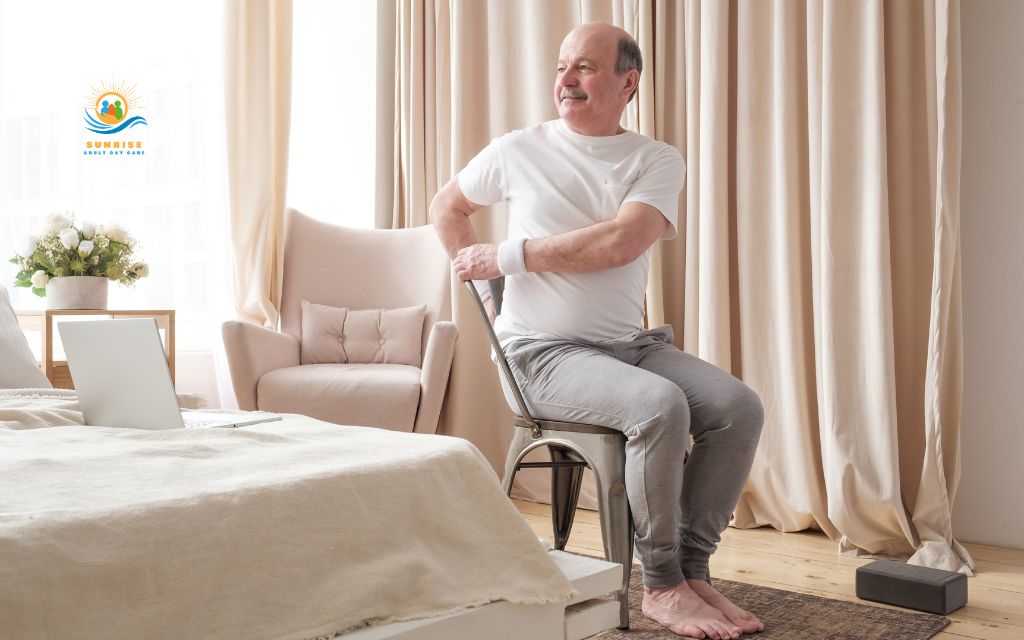
Seated tummy twists
Targets: Obliques, rotational core stability, spinal mobility
사용 방법:
- Sit tall with feet flat and arms crossed loosely across your chest.
- Inhale to prepare. As you exhale, gently rotate your upper body to the right, leading with your shoulder.
- Keep your hips and feet facing forward – only your torso should rotate.
- Hold the twist for 2 seconds, feeling a gentle stretch along the side of your torso.
- Return to center, then repeat to the left side.
Reps / Time: 8 – 10 twists per side, 2 sets
수정: Hold a light ball (or a folded towel) between your hands as you twist. This cue helps keep the movement smooth, intentional, and consistent in range.
Seated side bends
Targets: Obliques (side abdominals), lateral spinal mobility
사용 방법:
- Sit tall with feet flat and arms resting at your sides.
- Slowly lower your right hand toward the floor along the side of the chair, bending gently at the waist.
- Feel a gentle lengthening along the left side of your torso.
- Hold for 2 – 3 seconds, then return upright slowly.
- Repeat on the left side.
Reps / Time: 8 – 10 bends per side, 2 sets
수정: If reaching toward the floor causes any discomfort, place one hand on your thigh and bend only a few inches. The benefit comes from the movement, not the depth.
Seated ab tightening (core bracing)
Targets: Deep transverse abdominis
사용 방법:
- Sit comfortably with feet flat and your back gently supported.
- Breathe in slowly and fully through your nose.
- As you exhale, pull your belly button gently but firmly inward toward your spine.
- Hold this gentle contraction for 5 – 10 seconds while continuing to breathe.
- Release fully. That is one repetition.
Reps / Time: 10 repetitions, 2 – 3 times per day
Seated bicycle movement
Targets: Lower abdominals, obliques, coordination, light cardiovascular activity
사용 방법:
- Sit near the edge of your chair, hands resting lightly on the armrests for balance.
- Lift your right knee while simultaneously turning your upper body to bring your left shoulder toward that knee.
- Lower, then lift the left knee while turning the right shoulder toward it.
- Continue alternating in a smooth, controlled cycling motion.
- Keep the movement slow.
Reps / Time: 10 – 12 repetitions per side (alternating), 2 sets
수정: If the rotation portion is too challenging, remove the twist and simply alternate knee lifts while keeping your torso still. Add the rotation only when you feel ready.
Chair toe taps
Targets: Lower abdominals, shin muscles (tibialis anterior), light core activation
사용 방법:
- Sit upright with feet flat on the floor.
- Keep your heel on the ground and lift your right toes up toward your shin.
- Tap them back down gently.
- Alternate quickly but smoothly between right and left, like a gentle drumbeat.
- Keep your core lightly engaged and your back straight throughout.
Reps / Time: 30 – 45 seconds of continuous tapping, rest, repeat 2 – 3 times
수정: If alternating feels too fast, tap just one foot at a time for 15 seconds per side, then switch.
Seated lean back hold
Targets: Abdominal endurance, lower back stability, postural strength
사용 방법:
- Sit near the front edge of the chair, feet flat and shoulder-width apart.
- Cross your arms loosely over your chest or extend them in front.
- Slowly lean your torso back at a slight angle without touching the chair back.
- Hold this position with your core lightly engaged.
- Slowly return upright. That is one repetition.
Reps / Time: Hold for 5 – 10 seconds per rep, 8 – 10 repetitions, 2 sets
수정: Only lean back as far as you can comfortably hold without straining your neck or lower back. A very small lean is completely fine and still effective.
Seated arm reach with core engagement
Targets: Core stability, shoulder mobility, coordination, balance
사용 방법:
- Sit tall with feet flat and hands resting on your thighs.
- Tighten your core gently.
- Slowly raise your right arm forward and up toward the ceiling, as if reaching for something on a high shelf.
- Hold for 2 – 3 seconds, then slowly lower your arm.
- Repeat with the left arm, alternating sides.
Reps / Time: 10 reaches per arm, 2 – 3 sets
수정: If shoulder mobility is limited, raise the arm only to shoulder height rather than overhead. The core engagement is the primary benefit, regardless of how high the arm reaches.
Seated pelvic tilts
Targets: Lower back, deep abdominals, lumbar stability
사용 방법:
- Sit upright with feet flat, hands resting on your knees.
- Arch your lower back very gently, allowing your pelvis to tilt forward. You will notice a slight curve forming in your lower spine.
- Then, slowly flatten your lower back by gently rocking your pelvis backward, as if tucking your tailbone under.
- Continue this gentle rocking motion at a slow, controlled pace.
- Breathe naturally throughout.
Reps / Time: 10 – 12 slow repetitions, 2 sets
수정: Make the movement small and gentle. This is not about creating a big arch – even a subtle tilt activates the target muscles and can bring relief to a stiff lower back.
Seated heel slides
Targets: Lower abdominals, hip flexors
사용 방법:
- Sit back slightly in the chair for support, with both feet flat on the floor.
- Slowly slide your right heel forward along the floor, straightening the leg as far as comfortable.
- Hold for 2 seconds.
- Slowly slide the heel back to the starting position, bending the knee.
- Repeat on the left side. Alternate smoothly.
Reps / Time: 10 slides per leg, 2 sets
Seated cross-body reach
Targets: Obliques, core rotation, flexibility, shoulder and hip coordination
사용 방법:
- Sit tall with feet flat. Extend both arms out in front at chest height.
- Keeping your hips still, reach your right hand toward your left knee, rotating gently at the waist.
- Hold for 2 seconds, feeling the stretch along your right side.
- Return to center, then reach your left hand toward your right knee.
- Continue alternating in a slow, deliberate manner.
Reps / Time: 10 reaches per side, 2 sets
수정: If reaching across the body causes discomfort, simply place one hand on the opposite knee without reaching.
Seated punches
Targets: Upper abdominals, obliques, mild cardio
사용 방법:
- Sit near the front of the chair, feet flat, back upright.
- Make loose, relaxed fists with both hands and raise them to about chin height.
- Gently punch forward with your right hand, rotating slightly at the waist.
- Return, then punch with the left hand.
- Maintain a comfortable pace.
Reps / Time: 20 – 30 punches (alternating), 2 – 3 rounds
수정: If the punching motion causes shoulder discomfort, simply press both arms forward simultaneously (a double push) without the rotation. It is just as fun and effective.
Seated hold with breathing
Targets: Deep core stabilizers, diaphragm, mind-body connection and calm
사용 방법:
- Sit upright with both feet flat, hands resting comfortably on your thighs.
- Close your eyes if comfortable, or soften your gaze.
- Breathe in slowly through your nose for a count of 4, letting your belly expand.
- As you exhale slowly through pursed lips for a count of 6, gently draw your belly inward, engaging your deep core.
- Hold the gentle core contraction for 2 seconds at the end of the exhale. Release and repeat.
Reps / Time: 8 – 10 breath cycles, 1 – 2 times per session
수정: If counting feels stressful, simply breathe slowly and naturally while maintaining a gentle inward pull on your belly. There is no wrong way to do this mindful exercise.
Safety tips before you start
Even the gentlest exercise routine benefits from a few key safety practices. Following these guidelines will help protect you from unnecessary strain and ensure that each session is as effective as possible.
- Use a sturdy, stable chair without wheels: A dining chair or a firm armchair works well. Place it on a non-slip surface or position it against a wall for added stability.
- Sit upright near the front edge of the seat: This posture encourages natural core engagement and prevents slumping, which reduces the effectiveness of the exercises.
- Keep both feet flat on the floor: Feet should be hip-width apart. If your feet do not comfortably reach the floor, place a firm book or folded blanket underneath them.
- Move slowly and deliberately: Speed is not the goal. Controlled, intentional movement is what builds strength and reduces injury risk.
- Breathe naturally throughout every movement: Never hold your breath. Exhale during the effort (the lift, the reach, the twist) and inhale on the return.
- Stop immediately if you experience pain: Mild muscle fatigue is normal. Sharp pain, dizziness, shortness of breath, or chest discomfort are signs to stop and seek medical guidance.
- Consult your physician before beginning: This is especially important if you have recently had surgery, a fall, or a new diagnosis that affects your movement.
Who should be extra careful
While these exercises are designed to be low-risk, certain individuals should take extra precautions or consult a healthcare provider before attempting any seated core work:
- Seniors who have had recent abdominal, back, or hip surgery and have not yet been cleared for exercise by their surgeon or physical therapist
- Those experiencing severe or acute back pain, particularly pain that radiates down the legs, which may suggest nerve involvement
- Individuals with a diagnosis of severe osteoporosis, as certain spinal flexion movements may carry additional risks
- Seniors with balance disorders or vertigo, who may need additional support or supervision for movements that shift the body’s center of gravity
- Those with uncontrolled cardiovascular conditions – always seek medical clearance before adding new exercise to your routine
How often should seniors do sitting core exercises?
The American College of Sports Medicine (ACSM) recommends that older adults engage in muscle-strengthening activities at least 2 to 3 days per week. For seated core exercises specifically, a frequency of 2 to 4 sessions per week is ideal for most seniors, with at least one rest day between sessions to allow muscles to recover.
Each session does not need to be long. Starting with 10 to 15 minutes is perfectly appropriate, and can even be broken into two shorter 7-minute sessions if fatigue is a concern. As strength and endurance build, gradually extend to 20 minutes per session.
The most important principle here is consistency over intensity. Two gentle 15-minute sessions each week, done consistently over months, will deliver far greater results than occasional intense workouts followed by long rest periods.
Tips to stay consistent with sitting exercises
Knowing the exercises is one thing. Actually doing them every week, that is where many people struggle. Here are practical, proven strategies to help make seated core exercise a regular, enjoyable part of your life.
- Set a specific time each day: Pair your exercises with an existing routine, such as after your morning coffee, before lunch, or during your favorite morning program on television. Habits attach most easily to existing anchors.
- Exercise to music: Create a short playlist of upbeat, familiar songs that lasts about 15 – 20 minutes. When the music plays, the exercises happen. This also makes sessions feel lighter and more enjoyable.
- Partner up with a friend or family member: Accountability dramatically increases follow-through. Ask a spouse, neighbor, or adult child to join you – or arrange to do your routine at the same time as someone else, even via a phone call.
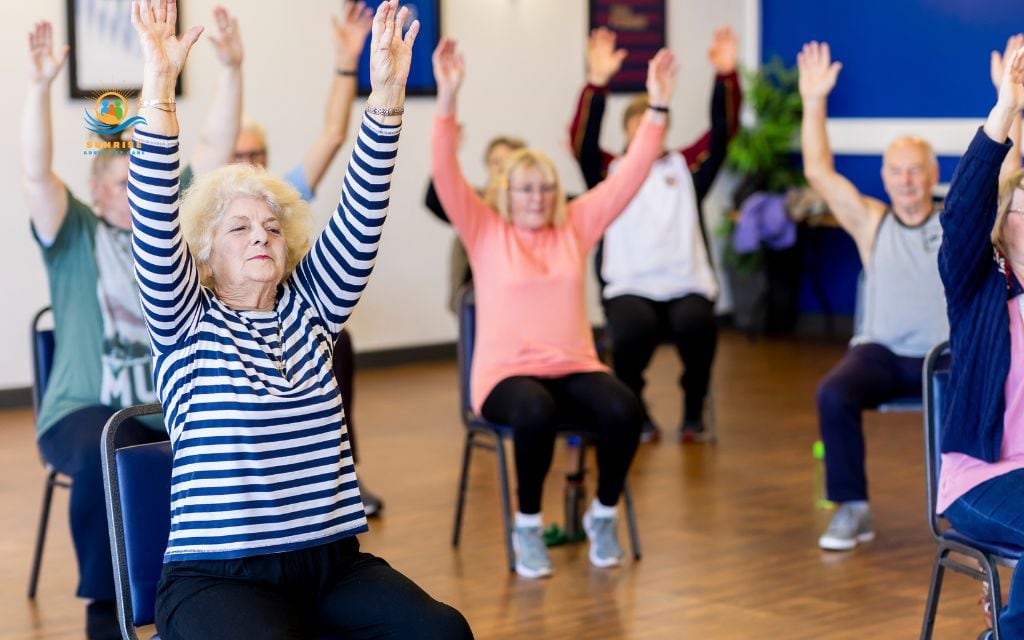
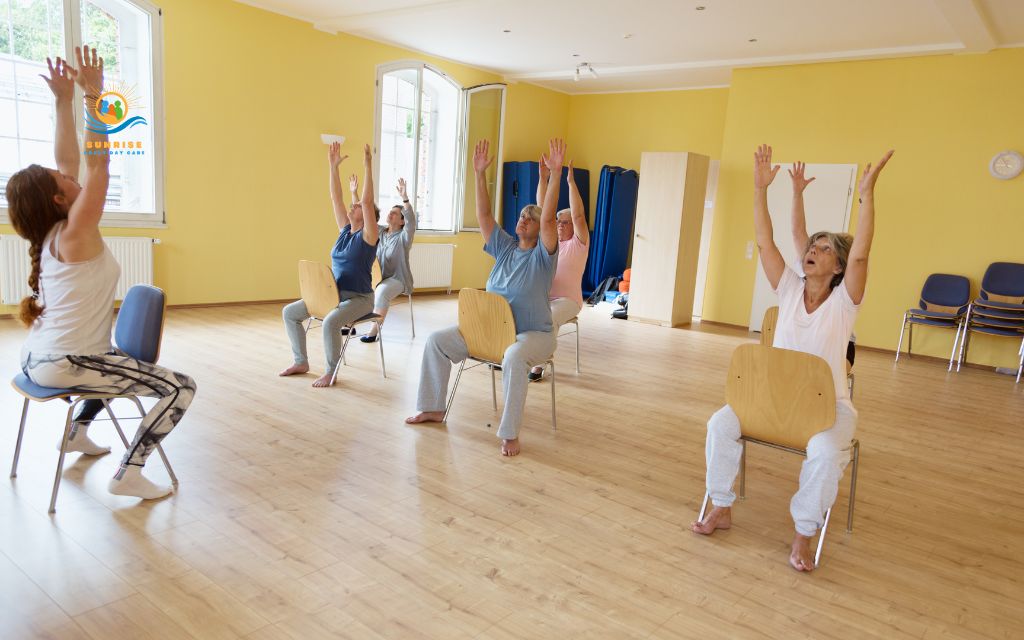
- Join a group exercise session: Exercising alongside others at a senior center or adult day program provides social connection, gentle encouragement, and the natural rhythm of a scheduled class.
- Track your progress simply: Use a small calendar and mark an ‘X’ on each day you complete your exercises. Watching a streak of Xs grow is surprisingly motivating.
- Celebrate small wins. Completing 10 repetitions this week when last week you could only do 6? That is a real improvement worth acknowledging. Progress in seniors’ fitness is often gradual, and every positive change matters.
How adult day programs support senior fitness
Exercising at home is a great starting point but for many seniors and their families, a structured daytime program offers something home exercise simply cannot.
성인용 데이 프로그램 like Sunrise Adult Daycare in Denver, CO incorporate gentle, seated fitness activities as part of a comprehensive daily program designed to support older adults’ physical, cognitive, and social well-being.
- Supervised chair workouts and seated core sessions: Trained staff guide participants through safe, appropriate exercises adapted to each individual’s ability level.
- Gentle group exercise classes: Moving alongside peers creates natural motivation and makes exercise feel social rather than like a chore.
- Consistent daily structure: Having a scheduled daytime program helps older adults maintain a healthy rhythm, which research links to better physical function, improved mood, and reduced cognitive decline.
- Social and cognitive engagement: Physical fitness is just one part of what adult day programs offer. Music, games, creative activities, conversation, and shared meals contribute equally to overall health and quality of life.
- 가족을 위한 마음의 평안: Family caregivers can feel confident knowing their loved one is in a safe, professionally supervised environment.
Curious about our adult daycare service? Call us at 303-226-6882 to schedule a tour today. We would love to meet you.
결론
The 15 sitting core exercises in this guide are proof that meaningful movement does not have to be complicated, painful, or exhausting. From a simple core brace to a gentle bicycle movement, every one of these exercises contributes to a stronger, more stable body.
Start with just 2 or 3 exercises. Do them twice this week. Then add one more next week. Small, consistent efforts build real strength over time – and the results show up where it matters most: in how freely and confidently you move through each day.
If staying consistent at home feels challenging, remember that you do not have to do this alone. A structured adult day program can provide the gentle guidance, social energy, and safe environment that helps you show up, move well, and feel better, every single week.
자주 묻는 질문(FAQ)
Are chair ab workouts effective for seniors?
Yes, and they are often more appropriate than floor-based ab exercises for older adults. Chair ab workouts target the rectus abdominis, obliques, and deep stabilizing muscles of the core while keeping the spine in a safe, supported position.
Can sitting exercises reduce belly fat?
Spot reduction is a common myth. Seated core exercises will strengthen and tone abdominal muscles, but reducing belly fat requires a broader approach that includes overall caloric balance, regular movement, adequate sleep, and stress management. That said, stronger core muscles improve posture and body composition over time, contributing to a firmer, more functional midsection.
How long before I see results?
Most older adults begin to notice functional improvements – such as less back discomfort, easier transitions from sitting to standing, and better balance – within 3 to 6 weeks of consistent practice (2 – 4 sessions per week). Progress varies based on starting fitness level, frequency, nutrition, and overall health. The most reliable predictor of results is consistency.
Are these safe for people with back pain?
Many of the exercises in this guide are commonly recommended by physical therapists for individuals with low back pain, because they strengthen the muscles that support the lumbar spine without harmful spinal loading. However, anyone with acute, severe, or radiating back pain should consult a physician or physical therapist before beginning.
Can caregivers assist with these exercises?
Absolutely. Caregivers play a wonderful role in supporting exercise participation. A caregiver can demonstrate movements alongside the senior, provide gentle verbal encouragement, offer light physical support if needed, and help track progress over time.