Staying physically active gets a lot of attention in the world of healthy aging. But there is another dimension of wellness that deserves just as much care: keeping the brain active. For older adults, maintaining mental sharpness is not just about remembering names and appointments. It is about feeling confident, engaged, and independent every single day.
Many seniors share the same quiet worries:
- Will my memory start to slip?
- Is my thinking getting slower?
- Will I eventually lose my independence?
You do not need expensive equipment or a clinical setting to begin. Many of the most effective brain training exercises for the elderly can be done at home, in a group, or as part of a daily routine.
For seniors who benefit from a consistent routine, social interaction, and professional oversight, structured adult day programs offer a ready-made environment where brain-stimulating activities happen daily – alongside companionship, safety, and care.
Why brain training exercises matter for the elderly
Cognitive engagement is not a luxury, it is a core part of healthy aging. Research shows that older adults who stay mentally active tend to maintain stronger memory, better focus, and a more positive sense of wellbeing.
Here is a closer look at the key benefits of regular brain health exercises.
Support memory and recall
As we age, the speed at which the brain processes and retrieves information can slow down. Activities that challenge memory such as word games, storytelling, or music,… help reinforce neural pathways associated with recall. Regular practice can make it easier to remember names, daily tasks, and important details. Think of these activities as a gentle, consistent workout for the memory centers of the brain.
Improve focus and attention
Sustained attention becomes more effortful with age. Cognitive exercises for elderly adults such as card games, number puzzles, or jigsaw puzzles,… require concentration and sequential thinking. Practicing these activities can help older adults stay focused during conversations, daily tasks, and decision-making situations. Improved attention also supports personal safety by helping seniors stay alert to their environment.
Boost mood and confidence
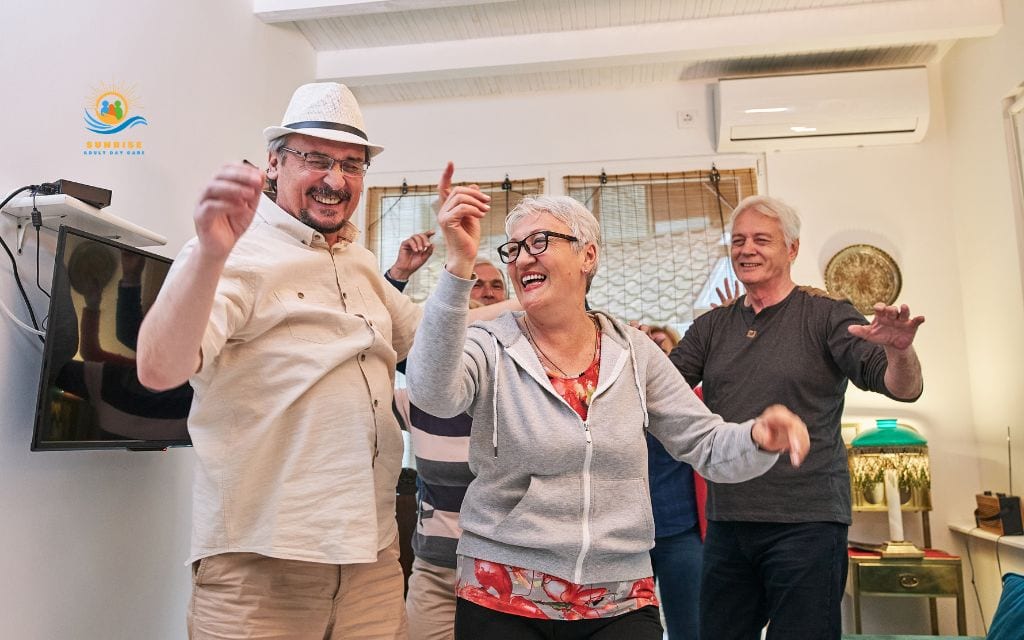
There is a well-established connection between mental engagement and emotional wellbeing. When seniors complete a challenging crossword puzzle, learn a new skill, or participate in a group activity, they experience a genuine sense of accomplishment.
This feeling builds confidence and counteracts feelings of helplessness or low self-worth that can accompany aging. Brain stimulating activities are not just good for cognition, they are good for the spirit.
Encourage daily engagement and purpose
One of the most overlooked aspects of cognitive health is the role of purpose and routine. Seniors who have daily activities to look forward to are more likely to stay engaged, social, and motivated. Mind exercises for seniors work best when they are embedded into a consistent daily rhythm, not treated as an occasional chore.
What makes a good brain exercise for older adults?
Not every mental challenge is well-suited for older adults. A good brain exercise balances stimulation with comfort, and challenge with accessibility.
Drawing on guidance from organizations like UCLA Health and the Alzheimer’s Association, here are the core qualities to look for when choosing cognitive exercises for seniors:
- Simple and easy to follow: Activities should have clear instructions that do not require lengthy learning curves or complex setup. Seniors should be able to participate without feeling overwhelmed.
- Repetitive but engaging: Consistency matters for cognitive benefit. Activities that can be repeated regularly are ideal. Variety within a familiar format (such as a new crossword every day) strikes the right balance.
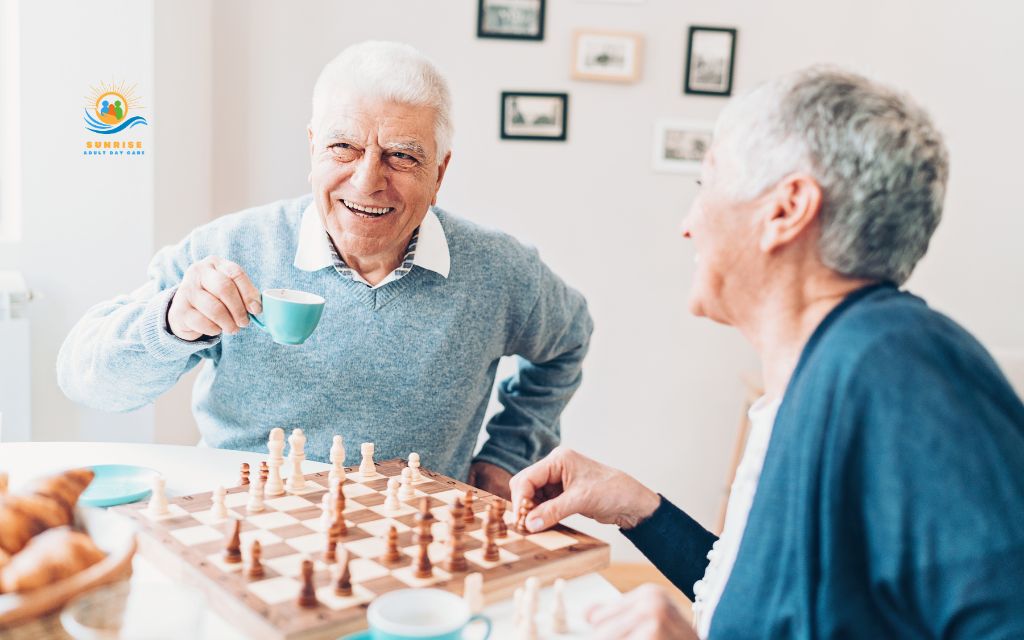
- Social when possible: Group-based activities add an emotional dimension that solo exercises cannot replicate. Social interaction itself is a form of cognitive exercise, it requires listening, processing, responding, and emotional regulation.
- Adaptable to different ability levels: A good brain exercise can be simplified for seniors with early cognitive changes or made more challenging for those who are cognitively sharp. Flexible activities ensure no one is left behind.
- Safe and low-stress: Mental strain is not the goal. The best brain exercises for seniors feel enjoyable and manageable, not frustrating or anxiety-inducing. A relaxed, positive atmosphere produces better engagement and better outcomes.
11 brain training exercises for the elderly
Each of the exercises below has been chosen because it is safe, practical, and well-suited to older adults. Whether done independently or as part of a structured group program, these brain exercises for the elderly can make a meaningful difference in daily mental function and quality of life.
1. Word games and crossword puzzles
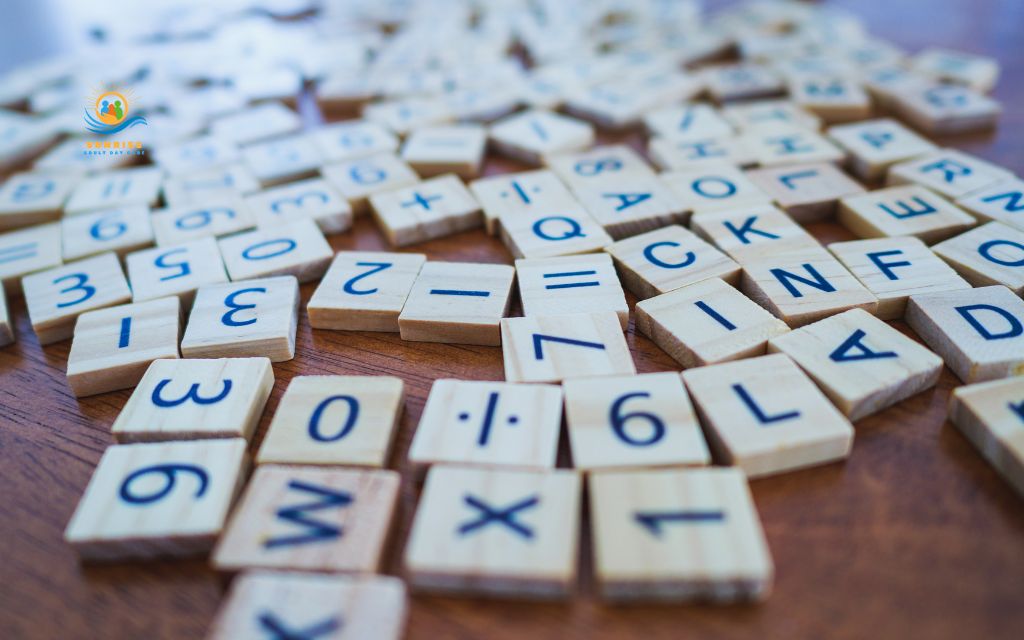
Start with a beginner or large-print crossword puzzle from a daily newspaper or puzzle book. Work through it at a comfortable pace. There is no timer required. Seniors can also enjoy word search grids, Scrabble, or simple word association games with a partner.
Tips and variations: For those new to crossword puzzles, start with themed puzzles based on familiar topics such as history, cooking, or music. Group word games add a social element that boosts engagement and enjoyment.
2. Memory matching games
Use a standard set of matching cards – available at most dollar stores or printable online. Lay cards face down and take turns flipping two at a time to find matching pairs. Digital versions are also available on tablets and computers for those who prefer a screen format.
Tips and variations: Customize the cards to include photos of family members, favorite places, or familiar objects to make the activity more meaningful. Reducing the number of card pairs makes the game accessible for seniors with mild memory challenges.
3. Reading and storytelling
Encourage daily reading whether books, magazines, or articles on topics of personal interest. After reading a passage, practice recall by summarizing what was read aloud or in writing. Storytelling circles, where each person contributes a sentence to an ongoing story, are a particularly enjoyable group version of this activity.
Tips and variations: Audiobooks are an excellent alternative for seniors with vision impairments. Large-print editions and e-readers with adjustable font sizes make independent reading more accessible for everyone.

4. Simple math or number games
Simple mental arithmetic is one of the most effective exercises for brain function. Try counting backward from 100 by threes, adding up grocery prices mentally, or completing beginner-level Sudoku puzzles. These activities engage the problem-solving centers of the brain without requiring formal mathematical training.
Tips and variations: Keep sessions short – 5 – 10 minutes of focused mental math is more beneficial and enjoyable than a long, exhausting session. Number bingo is a fun group alternative that combines math with social interaction.
5. Learning something new
Learning a new skill is one of the most powerful cognitive exercises for memory available to older adults. It challenges the brain to form new neural connections, which supports overall cognitive resilience.
Tips and variations: Community centers, libraries, and adult day programs often offer beginner classes in art, music, and language. Group learning environments are especially beneficial because they combine cognitive challenge with social connection.
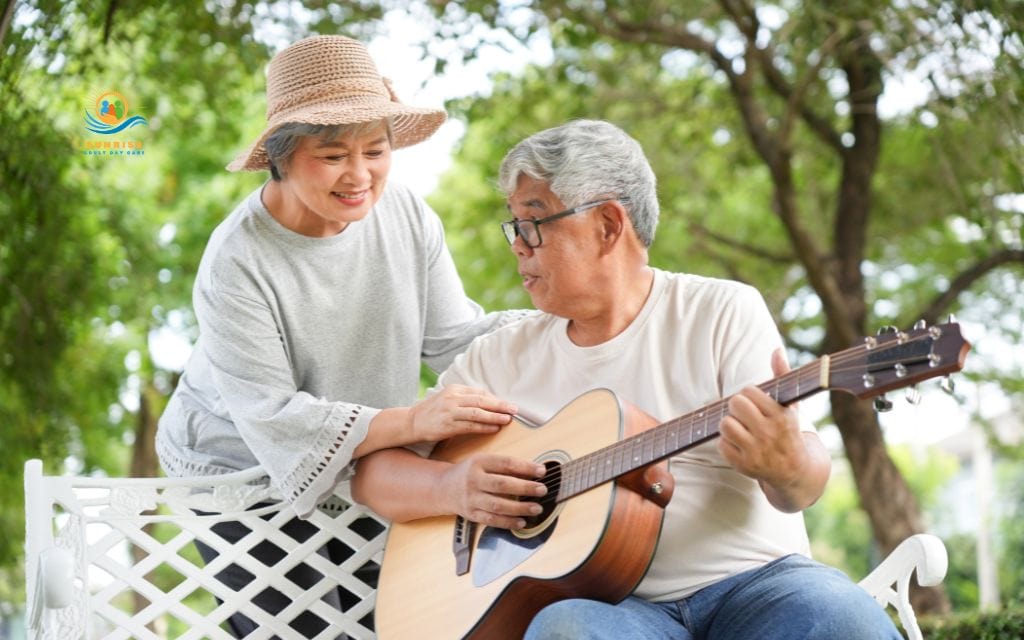
6. Music and singing
Listening to familiar songs from earlier decades can trigger strong autobiographical memories, making music one of the most emotionally resonant brain stimulating activities available.
Actively singing along engages multiple brain regions simultaneously, including those responsible for language, rhythm, and emotion. Group sing-alongs and music circles are particularly popular in adult day programs.
Tips and variations: Use printed song lyric sheets for group sing-alongs to keep everyone engaged. For seniors with dementia or significant memory impairment, familiar music from their youth may evoke recognition even when other memories are less accessible.
7. Card games (e.g., solitaire, bridge)
Classic card games like Solitaire, Bridge, Rummy, or Go Fish offer a wonderful combination of memory and strategic thinking. For group play, set up a weekly card game session. For solo play, a standard deck of cards or a tablet app works well at any time of day.
Tips and variations: Choose games that match the player’s current ability level. Simpler games like War or Snap are excellent starting points for those new to card games, while Bridge or Pinochle offer greater challenge for experienced players. Playing regularly builds meaningful cognitive habits over time.
8. Jigsaw puzzles
Choose a jigsaw puzzle with a manageable piece count – 100 to 300 pieces is a good range for most older adults. Work on the puzzle over several sessions rather than trying to complete it in one sitting. Place the puzzle on a dedicated tray or table where it can remain undisturbed between sessions.
Tips and variations: Puzzles featuring familiar images tend to be more engaging. For seniors with arthritic hands or reduced grip strength, consider larger-piece puzzle sets designed specifically for older adults. Group puzzle sessions can also become a relaxing, sociable weekly activity.
9. Writing or journaling
Encourage seniors to write a few sentences each day about a memory, a current event, or something they are grateful for.
Journaling does not need to be lengthy or literary – a simple daily entry of 2 or 3 sentences is enough to stimulate cognitive and emotional engagement. Guided journaling prompts (such as “Describe a meal you remember from your childhood”) can make starting easier.
Tips and variations: For seniors who find handwriting difficult, dictation tools or voice-to-text apps offer an accessible alternative. A shared group journaling project can be a deeply meaningful activity in senior care settings.

10. Social conversation activities
Structured social conversations are among the best brain exercises for seniors because they engage multiple cognitive functions at once – attention, language, memory, and empathy.
Try organizing regular discussion groups around topics like current events, favorite films, travel memories, or personal life stories. Even casual, daily conversations with family or caregivers count as meaningful cognitive stimulation.
Tips and variations: Discussion groups benefit from a gentle facilitator who can guide the conversation, ensure everyone participates, and redirect when needed. Reminiscence-based conversations are especially effective because they tap into long-term autobiographical memory, which often remains well-preserved in older adults.
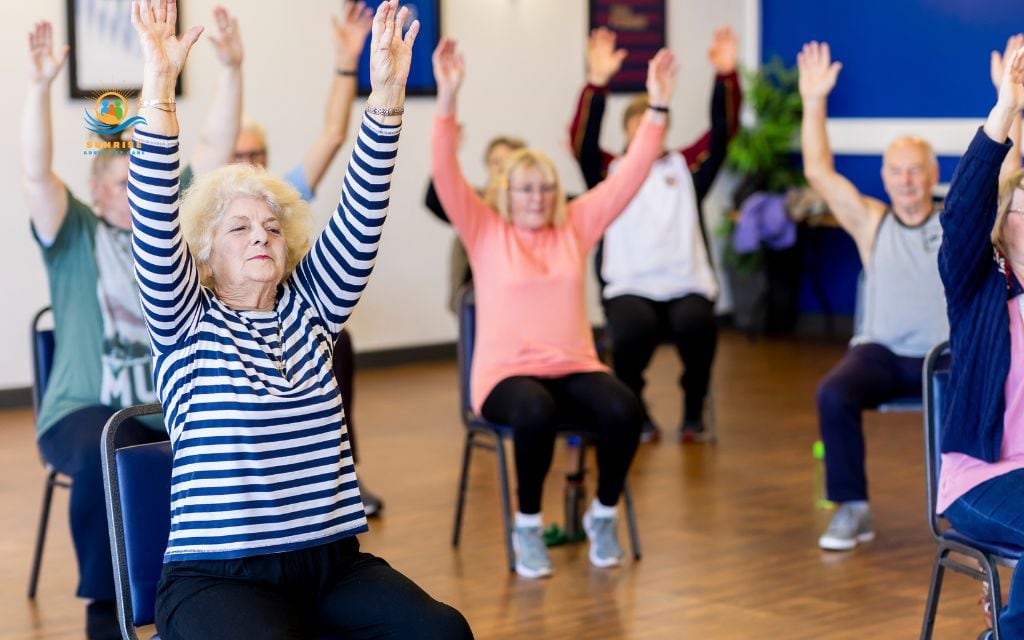
11. Brain-body exercises (e.g., chair yoga + counting)
Combining physical movement with mental tasks is one of the most powerful approaches in brain training for seniors.
A simple example is chair yoga with counting: perform a gentle seated stretch sequence while counting repetitions aloud in a second language or backward from 20.
Other examples include walking and naming categories aloud (colors, animals, countries) or doing arm stretches while recalling a poem or song.
Tips and variations: Dual-task exercises should always be adapted to each person’s physical ability. Chair-based versions are safe for seniors with balance concerns or limited mobility. Starting with simple tasks and gradually increasing the complexity keeps the activity both safe and engaging.

Brain health exercises beyond “games”
Brain training is not limited to puzzles and card games. A truly comprehensive approach to cognitive wellness for older adults includes lifestyle factors that support brain health from multiple angles.
These are the pillars that make other cognitive exercises more effective:
- Physical movement: Regular gentle exercise such as walking, stretching, swimming, or chair aerobics,… improves blood flow to the brain and has been consistently linked to better cognitive function. Even a 20-minute daily walk can make a difference in mental sharpness and mood.
- Healthy sleep habits: The brain consolidates memories and clears metabolic waste products during sleep. Seniors who get adequate, consistent sleep – typically 7 – 9 hours per night – tend to have better memory, attention, and emotional regulation. Poor sleep is one of the most underappreciated contributors to cognitive decline.
- Nutrition and brain-friendly foods: A diet rich in leafy greens, berries, fatty fish, nuts, and whole grains supports long-term brain health. The MIND diet – a hybrid of the Mediterranean and DASH diets – has been associated with slower cognitive aging in research studies. Staying well-hydrated is important, as even mild dehydration can impair concentration and short-term memory.
- Meaningful social interaction: Loneliness and social isolation are associated with a significantly higher risk of cognitive decline. Regular, meaningful contact with family, friends, or community members provides emotional stimulation that supports brain health.
Tips to make brain exercises more effective
Choosing the right activities is only half the equation. How seniors engage with brain training exercises matters just as much as which activities they choose.
Keep these practical tips in mind:
- Keep sessions short (10 – 20 minutes): Brief, focused sessions are more effective and more enjoyable than extended, exhausting ones. The goal is consistent stimulation, not mental fatigue. It is perfectly fine to do two short sessions a day rather than one long one.
- Stay consistent (daily or weekly routine): Regularity is more important than intensity. A consistent schedule builds cognitive habits over time. Even 5 minutes of mental engagement each day is more beneficial than 1 hour once a week.
- Mix different types of activities: The brain benefits from variety. Combining language-based exercises (crosswords, reading) with visual-spatial tasks (puzzles, art) and social activities (conversation groups, card games) engages a broader range of cognitive functions than relying on a single type of activity.
- Make it enjoyable: The most effective brain training happens when the activity feels pleasurable, not like a test. If a particular exercise causes frustration or anxiety, switch to something more comfortable. Positive emotional engagement enhances memory consolidation and learning.
How adult day programs support cognitive health
Adult day programs, sometimes called adult day care or senior day programs, are structured daytime services for older adults who benefit from supervision, social engagement, and stimulating activities during the day.
According to the Administration for Community Living, adult day programs provide a supportive community environment where participants can socialize, receive health monitoring, and engage in purposeful activities.
Structured brain-stimulating activities
Quality adult day programs incorporate daily cognitive activities into their schedules, including music sessions, word games, memory exercises, arts and crafts, and group discussions.
Unlike informal home activities that may be irregular or incomplete, structured programs provide planned, supervised brain training exercises for seniors on a consistent basis.
Staff members are trained to adapt activities to each participant’s ability level, ensuring that everyone can participate safely and meaningfully.
Social engagement and group interaction
Social isolation is one of the leading risk factors for cognitive decline in older adults. Adult day programs address this by providing a daily community of peers.
Participants enjoy shared meals, group activities, and natural conversation throughout the day – creating the kind of consistent, meaningful social engagement that is difficult to replicate at home.
The relationships formed in these settings also contribute to emotional wellbeing and a stronger sense of identity and belonging.
Routine and consistency
One of the most underappreciated benefits of adult day programs is the structure they provide. A predictable daily schedule gives older adults a sense of purpose and orientation that supports cognitive health. Routine reduces anxiety, simplifies decision-making, and creates a stable framework within which brain training activities happen naturally every day.
Supervision and safety
Many families worry about leaving an aging parent or spouse home alone during the day. Adult day programs provide professional supervision throughout the day, with staff trained to monitor health conditions, administer medications, assist with mobility, and respond to emergencies. This level of oversight allows older adults to engage confidently in activities without the risks associated with unsupervised time at home.
Sunrise Adult Daycare in Denver, CO
At Sunrise Adult Daycare, we provide a warm, structured daytime environment where seniors engage in daily brain-stimulating activities, enjoy meaningful social connections, and receive caring professional support.
We are a daytime program designed to help older adults stay engaged, confident, and independent. Schedule a visit today to see how our program can support your loved one’s cognitive health, social life, and daily wellbeing. Call us: 303-226-6882.
Conclusion
The journey toward lasting mental sharpness does not require extraordinary effort – it requires small, consistent habits repeated every day. Word games, music, meaningful conversations, a daily walk, and a good night’s sleep are all pieces of the same puzzle.
None of them is a cure, and none should be presented as one. But together, they form a lifestyle that supports cognitive engagement, emotional wellbeing, and daily independence.
The research is clear that mental activity combined with social connection produces stronger outcomes than either alone. When older adults have people around them, their engagement deepens, their mood improves, and the benefits of cognitive activity multiply.
If you are caring for an aging parent or loved one and looking for a supportive daytime option, we invite you to explore what a local adult day program can offer.
Frequently asked questions (FAQs)
Do brain exercises really help memory?
Yes. Regular engagement in mentally stimulating activities has been associated with better memory recall, improved attention, and slower age-related cognitive changes. Activities like reading, word games, music, and social conversation all help reinforce the neural pathways involved in memory.
What are the best brain exercises for seniors?
The best brain exercises for seniors are activities that are enjoyable, socially engaging when possible, and varied enough to challenge different cognitive functions. Top choices include crossword puzzles, memory card games, reading and storytelling, music and singing, card games, jigsaw puzzles, journaling, learning something new, and structured social conversation. Combining these with physical movement creates an even more comprehensive approach to cognitive wellness.
How often should seniors do cognitive exercises?
Daily engagement is ideal, but consistency matters more than frequency. Even short sessions of 10 to 20 minutes each day are more beneficial than occasional long sessions. A good goal is to incorporate at least one cognitively engaging activity into each day, whether that is a morning crossword, an afternoon card game, or an evening conversation about shared memories.
Can brain games prevent dementia?
This is an important question, and the honest answer is: no, not definitively. While regular cognitive engagement is associated with better brain health outcomes in aging, there is currently no evidence that any specific brain game or mental activity can prevent dementia or Alzheimer’s disease.
Are group activities better than solo exercises?
Group activities offer cognitive benefits that solo exercises cannot fully replicate. Engaging with others requires active listening, verbal processing, emotional awareness, and real-time problem-solving. Group activities also address social isolation, which is itself a significant risk factor for cognitive decline.